Traduction".
Texte paru dans: / Appeared in: |
|||||||
|
|
|||||||
|
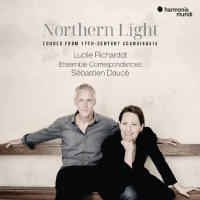
This engaging, generous album takes us to the royal Swedish court in the second half of the late 17th century. Most of the music comes from the so-called Düben collection, a substantial compendium that testifies to the court’s cosmopolitan character. (It is named after the master of the royal chapel who died in 1690 after a lengthy tenure.) With just a handful of strings and an uncredited recorder, a sizeable continuo (including bassoon and harp alongside the more usual theorbo, harpsichord and organ) and a vocal quartet (corresponding exactly to the membership of Düben’s band), Ensemble Correspondances conjure up an intimate, focused sound world, in which every detail tells. But the star of the show is soloist Lucile Richardot, who is listed as a mezzo but might at times be mistaken for a countertenor. She shines in the miniature cantatas that open the recital. A good example is her subtle handling of the many repeats of chromatic material in Christian Geist’s Es war aber an der Stätte, a recounting of Christ’s burial for which obtrusive ornamentation would be inappropriate; in the hands of a lesser singer these repeats might tax the hearer’s patience, but anyway hers is a voice to sustain an entire programme with ease. Another highlight is Johann Christoph Bach’s famous lament Ach, dass ich Wasser’s g’nug hätte. The strings’ opening ritornello is a splendid bit of playing, and one is equally absorbed by Richardot’s interaction with the first violin. I was less taken by the selections from Italian composers, in the vein of Buxtehude’s Membra Jesu nostri but less distinctive; but Christian Ritter’s Italianate, Christmas-themed lullaby Salve, mi puerule introduces a celebratory note to what is otherwise a restrainedly sombre programme; sombre but highly intelligent and (again) absorbing. It ends with two repurposed Swedish-texted motets bookending the reign of King Charles XI, one recalling his coronation, the other his death some 20 years later. |
|||||||
|
|||||||
|
|
|
||||||
|
Cliquez l'un ou l'autre
bouton pour découvrir bien d'autres critiques de CD |
|||||||