Traduction".
Texte paru dans: / Appeared in: |
|||||||
 |
|
||||||
|
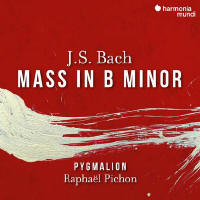
Expectations of a Mass in B minor from Pygmalion and Raphaël Pichon are considerable after a St Matthew Passion (4/22) that many considered the work’s most notable ‘reset’ in characterisation and drama since Karl Richter’s first recording in 1958 – with a roster of similarly outstanding soloists. The Mass has a different kind of challenge: the Ordinary of the Mass is not a narrative, more a legacy-anthology of all the prevailing idioms of Bach’s career until his final year.
As Peter Wollny remarks in his authoritative note, the real challenge for Bach’s parodying of material from preexisting cantatas was to combine so many eclectic styles into a dazzlingly coherent whole. In this respect alone, Pichon is something of a master because the links between the antique and modern are emboldened by illuminating conceits and contrasts at every stage of the journey. As the starting point, the music is taken entirely on its own terms – essentially Pichon’s personal vision – and so the wellrehearsed tropes of established ‘period’ vocabulary are quietly jettisoned for the freshly minted. The Kyrie and Gloria unfold with a piquancy that marks out the opening forays of Pygmalion’s recent Mozart Requiem (12/24), though Pichon takes his time here to let the abstraction settle in the first mighty fugue (which Mozart’s work doesn’t afford in the same way), gradually peeling away each contrapuntal layer with ever more urgent points of arrival. If there is one small gripe here, it’s the way he tends not to release at cadential points but ploughs on (7'54" is a case in point) towards the next alluring goal. Much of the enchantment resides within the solos. It’s hard not to mention something particularly striking about all of them. Julie Roset and Beth Taylor are perfectly pitched in the elegant tactus of the ‘Christe eleison’, offset against the slabs of liturgical polyphony either side. Taylor’s deeply responsive ‘Laudamus te’ is replete with colour and nuancing, and a ‘Dominus Deus’ from Roset and tenor Emiliano Gonzalez Toro has a refinement, in both balance and shading, that evokes an unalloyed love duet. The pair of gossiping bassoons underpin the chutzpah of Anneke Scott’s horn in the ‘Quoniam’ to support Christian Immler’s resounding panache. The ‘Benedictus’ is beatific in Toro’s hands and Lucile Richardot’s ‘Agnus Dei’ explores her rare capacity to drill into the bone of music and text.
If there is one repeating challenge in translating Bach’s conception on paper to performance, it lies in how to manage the pacing from the Credo onwards; how often the second half feels like a compendium of unconnected set-piece movements, compounded by D major trumpet-led choruses over-staying their welcome. Pichon’s long-term planning and attention to detail disperse any such fears with élan, from the moment the Gloria is released out of the trap like an eager young greyhound. The ensemble instantly transform it into a ravishing ballroom swirl (as later in the ‘Hosannas’) only stopped in its tracks by an ‘Et in terra pax’ of almost unbearable beauty. Likewise, the Credo feels like a bustling crowd scene, a kind of manifesto with trumpets and oboes jockeying for position.
In each of these big movements – including as regal a Sanctus as you’ll ever hear – there are endless shifts in textural and timbral interest. The choir tend more towards a lithely enunciated and openvowelled approach (especially in the passionate glow of the sopranos) than, say, the richly articulated and even brilliance of the Monteverdi Choir. This is the area where Pichon may not offer quite the same rhythmic swagger or quixotic definition of Gardiner, instead seeking an integrated vocal and instrumental language that prioritises pungency and homogeneity. The fragility of humanity is another outstanding hallmark of Pichon’s vision: the ‘Et incarnatus’ avoids the generically marmoreal, setting up a searing tombeau in the thrusting jabs of the ‘Crucifixus’. The recorded sound brilliantly reinforces Pichon’s refinement in artistic decisions. It takes the music on flights where interpretative investment and moments of risk seem to collide until the last elasticated and triumphant strains of the ‘Dona nobis pacem’. In the 2020s, the Passions and the Mass – through the good offices of Herreweghe, Suzuki and Pichon – have elevated the catalogue with some flourish. This B minor Mass is really up there with the very best. |
|||||||
|
|||||||
|
|
|
||||||
|
Cliquez l'un ou l'autre
bouton pour découvrir bien d'autres critiques de CD |
|||||||