Traduction".
Texte paru dans: / Appeared in: |
|||||||
 |
|
||||||
|
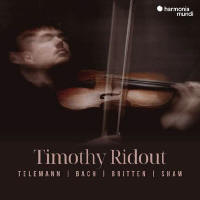
To get a sense of what Ridout does on this new album, one should listen to his and pianist Frank Dupree’s arrangement of Schumann’s Dichterliebe on ‘A Poet’s Love’ (A/21): there’s a similar approach to the highly expressive cantabile shaping of phrases; where however the piano there provided the richer and more expansive textures, it’s left to the dramatic bariolages here to provide such contrasts. The result is a sense of cohesion and differentiation that deliberately flattens the stylistic and historicist elements of the music while foregrounding the expressive uniqueness of each work. Thus, the Sarabande from Bach’s D minor Partita resonates freely not just with the slower movements of the two Telemann fantasias but with the more haunting, lyrical passages in the Britten and the Shaw.
Likewise, Ridout’s electrifying crossstring bowing of those bariolage paragraphs in the Shaw and the Bach Chaconne serves to throw into sharp relief his delicately sculpted melodic passages, whether plucked or bowed. And how good it is to hear a fresh recording of the Bach on the darkertoned viola, one in which Ridout arguably has the edge on, for example, Scott Slapin’s otherwise excellent account (Eroica, 2000).
This is yet another terrific release from Ridout, who again
plays a 16th-century Peregrino di Zanetto with all the soul and panache of an
Old Master. |
|||||||
|
|||||||
|
|
|
||||||
|
Cliquez l'un ou l'autre
bouton pour découvrir bien d'autres critiques de CD |
|||||||